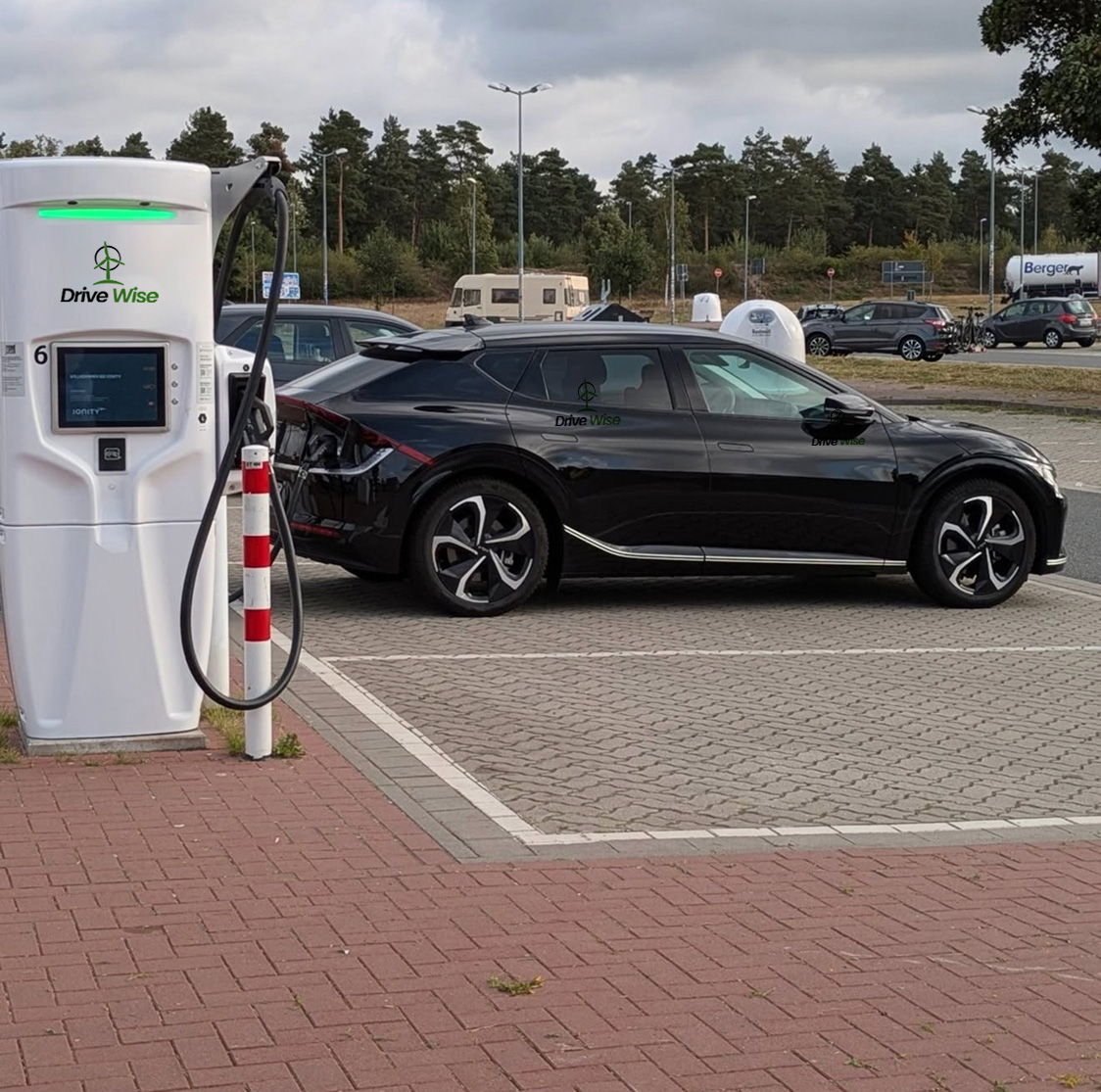
Drive Wise innovations and the EV Charging Boom: What History Tells Us About the Next Great Infrastructure Investment
Every few decades, a new infrastructure asset class emerges that quietly separates early believers from everyone else. The railroads did it in the 1800s. The interstate highway system did it in the mid-20th century. And in the early 1900s, a far more mundane invention, the gasoline filling station, created generational wealth for the families and investors who recognized what was coming before the rest of the country caught on.
I started researching this topic with genuine skepticism. The EV charging industry is saturated with hype, press releases, and breathless predictions about a fully electric future. But beneath the noise, I wanted to know whether there is a real, investable infrastructure opportunity here, or whether this is just another tech bubble dressed up in green packaging.
What I found is that the historical parallel is stronger than most people realize, and the investment landscape is already taking shape in ways that look remarkably familiar.
The Gas Station Wealth Model: A History Lesson Worth Revisiting
In the 1910s and 1920s, gasoline stations were not the branded, standardized fixtures we know today. They were curbside pumps outside general stores, often operated by local mechanics or general merchants who saw an opportunity. The automobile was still a novelty. Roads were unpaved. The idea that every American family would eventually own a car seemed absurd to most.
Yet the investors who acquired land, installed pumps, and secured distribution agreements in those early decades built empires. The Gulf Oil family, the Sinclair family, the early Standard Oil franchise holders, these were not oil tycoons in the traditional sense. They were infrastructure owners. They owned the physical points where a new form of transportation refueled. By the 1950s, a single well located gas station in a growing suburb could generate returns that far exceeded what most stock market investors earned during the same period.
The pattern is consistent across infrastructure history. Those who own the physical nodes, the fixed points where demand must converge, tend to outperform those who merely bet on the technology itself. Railroads made money, but the landowners and station operators often did better. Airlines struggled for profitability for decades, but airport operators and lessors of terminal space built reliable fortunes.
The question is whether EV charging stations represent the same kind of node, and whether the window for early infrastructure ownership is still open.


The Numbers Behind the EV Charging Gap
The electric vehicle transition is no longer theoretical. According to the Edison Electric Institute, the United States is projected to have approximately 78.5 million electric vehicles on the road by 2035, up from roughly 4.5 million at the end of 2023. Annual EV sales are forecast to reach nearly 12.2 million by 2035, representing approximately 72 percent of total light duty vehicle sales.
To support that fleet, the EEI estimates that more than 42.2 million charge ports will be needed across the United States by 2035, including roughly 325,000 public DC fast charging ports. As of August 2024, the industry still needed to install approximately 140,000 DC fast chargers and 1.9 million Level 2 chargers between then and the end of 2030 just to meet projected demand.
That gap is the core of the investment thesis. The global EV charging infrastructure market was valued at approximately USD 40.26 billion in 2025 and is projected to reach between USD 457 billion and USD 492 billion by 2035, representing a compound annual growth rate of roughly 26 to 28 percent.
In other words, the industry is not asking whether EV charging infrastructure will grow. It is asking whether the buildout can happen fast enough. And whenever supply struggles to keep pace with demand, the owners of scarce infrastructure tend to benefit.
Who Is Actually Building This Infrastructure?
The EV charging landscape is crowded, which is exactly what you would expect in a rapidly expanding market. Publicly traded companies such as ChargePoint, EVgo, and Blink Charging have been deploying networks for years, each with different geographic focuses and business models. ChargePoint operates one of the largest networks in North America, with hardware and software solutions for commercial and residential customers. EVgo has concentrated on fast charging in metropolitan areas, often partnering with retail locations. Blink Charging has pursued a more distributed approach, targeting workplaces, multi family dwellings, and smaller commercial sites.
Then there is the Tesla Supercharger network, which has historically been closed to non Tesla vehicles but is gradually opening to other brands, potentially reshaping competitive dynamics across the entire industry. Tesla's infrastructure advantage, built over more than a decade, gives it a footprint that newer entrants will struggle to replicate quickly.
On the private side, companies such as Electrify America, backed by Volkswagen, and smaller regional operators are also expanding. Infrastructure funds and private equity firms have begun acquiring charging station portfolios as yield generating assets, treating them similarly to cell towers or data centers.
And then there are newer models that allow individuals to invest directly in specific charging stations rather than buying stock in a large corporation. Platforms such as Drive Wise innovations offer fractional ownership structures where investors purchase shares in individual charging stations and receive monthly distributions based on the revenue those specific stations generate. This model is still emerging, but it represents a direct physical asset play that mirrors, in some ways, how early gas station investors acquired individual properties.
How an Everyday Investor Can Actually Participate
For someone reading this and wondering how to access the EV charging investment opportunity, the options are broader than they were even five years ago.
The most straightforward path is public equities. ChargePoint, EVgo, and Blink Charging are all traded on U.S. stock exchanges. These companies offer exposure to the growth of the charging network without requiring an investor to select individual locations or manage physical assets. The risk, of course, is that these companies are still scaling and have faced significant volatility. Their stock prices have reflected both the optimism and the uncertainty of a young industry.
A second option is exchange traded funds or clean energy funds that hold positions in charging infrastructure companies alongside solar, wind, and battery manufacturers. Funds such as the Global X Autonomous and Electric Vehicles ETF or the iShares Global Clean Energy ETF provide diversified exposure without concentrating risk in a single charging network operator.
A third and less conventional path is fractional ownership in individual charging stations. Under this model, which companies such as Drive Wise innovations are pursuing, an investor buys shares in a specific physical charging station installed at a high traffic location. The station generates revenue from charging sessions, and after management and maintenance fees are deducted, the remaining profit is distributed to shareholders monthly. This is not stock market investing. It is direct infrastructure ownership, more akin to owning a rental property or a share of a private gas station lease.
For accredited investors, venture capital and private equity funds focused on EV infrastructure offer another avenue, though these typically require larger capital commitments and longer lockup periods. Some infrastructure funds have begun acquiring operational charging stations as yield producing assets, treating them as part of a broader alternative infrastructure portfolio.
Each of these paths carries a different risk profile, liquidity profile, and capital requirement. The key point is that the industry has matured enough to offer multiple entry points, not just one.
Why Charging Stations Are Being Treated as a Serious Asset Class
Several structural factors make EV charging stations attractive as long term investments, and they are worth examining without the marketing gloss.
First, the demand is recurring and non discretionary in a practical sense. Once an EV driver establishes a charging routine, whether at a workplace, a shopping center, or along a highway corridor, that behavior tends to persist. Unlike discretionary retail, EV charging is a utility like consumption pattern. Drivers need to charge, and they will pay for access.
Second, the asset is physical and fixed. A charging station in a premium location, a shopping mall parking lot, a business park, or a highway rest stop, has locational scarcity. You cannot simply move it if a competitor opens nearby, but by the same token, a well positioned station benefits from barriers to entry. Securing utility connections, permits, and prime real estate is not trivial.
Third, the EV transition is structural, not cyclical. This is not a fad or a fashion. Government policy, automaker commitments, battery cost declines, and consumer preference shifts are all pushing in the same direction. Even in jurisdictions where political winds have shifted, the underlying technology and cost curves continue to favor electrification. Canada, for example, recently replaced its hard mandate with a more flexible emissions standard approach, but still projects a 75 percent EV adoption rate by 2035 and has allocated CAD 1.5 billion specifically for charging infrastructure buildout.
Fourth, the supply of public charging infrastructure is constrained relative to the number of EVs hitting the road. That supply demand imbalance is what creates pricing power for station owners over time.
The Risks Nobody Should Ignore
No serious analysis of this industry can omit the risks, and they are substantial.
Utility costs are a major variable. Charging stations consume large amounts of electricity, and in many jurisdictions, demand charges, time of use rates, and grid upgrade costs can erode margins significantly. A station that looks profitable on paper can become a loss maker if local utility pricing changes.
Location dependency is critical. A charging station in a high traffic shopping center with long dwell times is a very different asset from one in a low traffic strip mall where drivers have no reason to linger. Site selection is everything, and not every location will perform.
Competition is intensifying. The Tesla Supercharger network's opening to non Tesla vehicles, the expansion of ChargePoint and EVgo, and the entry of new players all mean that pricing pressure and market share battles are likely. The first mover advantage is real, but it is not permanent.
Regulatory uncertainty remains. While the long term direction favors EVs, short term policy shifts can affect subsidy levels, tax treatment, and permitting timelines. The U.S. federal landscape has shifted notably in 2025 and 2026, with the repeal of certain clean vehicle tax credits and changes to emissions regulations. Canada has similarly moved from mandates to incentive based frameworks. These changes do not kill the industry, but they add complexity.
The industry is also relatively early stage. Many charging networks are still unprofitable at the corporate level. The path to sustained profitability depends on utilization rates, pricing power, and operational efficiency that are not yet proven at scale everywhere.
Where This Is Headed Over the Next Decade
Looking five to ten years ahead, the EV charging investment landscape will likely look very different from today.
Consolidation is probable. The current fragmented landscape of dozens of network operators will probably narrow to a handful of dominant players, much as the early gas station industry consolidated into the major brands we recognize today. Some of today's charging companies will be acquired. Others will fail. A few will emerge as the infrastructure equivalent of the major oil companies.
The business models will also mature. We are likely to see more hybrid approaches, where charging stations are bundled with energy storage, solar generation, or grid services. The station itself becomes a node in a broader energy ecosystem, not just a place to plug in.
For individual investors, the fractional ownership model may grow from a niche offering into a more mainstream way to access physical infrastructure yields. If platforms such as Drive Wise innovations and similar operators can demonstrate consistent returns and transparent operations, they could attract capital from investors who want direct asset exposure without the complexity of owning and operating stations themselves.
And the geographic expansion will continue. While North America and Europe are the current focus, the Asia Pacific region already dominates global charging infrastructure deployment and will likely account for over 36 percent of the market by 2035. Global capital will flow toward wherever the buildout is happening fastest.
A Final Thought
The history of infrastructure investing is not about betting on the newest technology. It is about owning the fixed points where demand must go. The early gas station investors did not need to believe that the internal combustion engine was the final word in transportation. They simply needed to recognize that, for the foreseeable future, cars would need fuel, and the people who controlled the pumps would collect a toll on every mile driven.
EV charging stations may be following a similar arc. The technology is different. The politics are messier. The risks are real. But the underlying logic, that scarce infrastructure in a growing market tends to appreciate in value, is as old as investing itself.
Whether that opportunity justifies a position in your portfolio depends on your risk tolerance, your liquidity needs, and your view of how quickly the transition will unfold. What is no longer in doubt is that the infrastructure is being built, the capital is flowing, and the early ownership structures are already forming. The only question is who recognizes the pattern in time.